Optimization of the Air Conditioning System for an Unoccupied Office Building using Split Unit and Double-Panel Radiator
Abstract
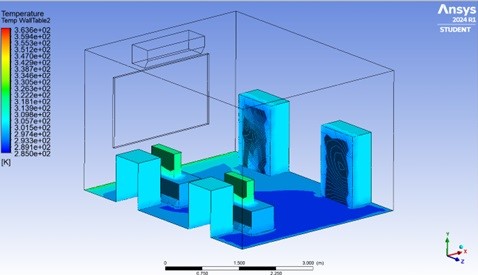
Ensuring a comfortable indoor environment in office settings is crucial for maintaining worker productivity and health. This study leverages computational fluid dynamics (CFD) to analyze and optimize the air conditioning system of a mid-sized office building, addressing issues of uneven temperature distribution and energy inefficiency. By creating a detailed CAD model of the office and performing CFD simulations using the k-ε turbulence model, we identified specific zones with temperature inconsistencies and assessed the factors contributing to these variations. Our results indicate that relocating the air conditioning unit to the corridor wall significantly improves temperature uniformity and reduces energy consumption compared to other placements. The findings highlight the potential of CFD in enhancing HVAC system design, thereby improving occupant comfort and reducing operational costs. This study contributes to the broader goal of optimizing energy use in commercial buildings and demonstrates practical applications of CFD in real-world settings. In this project we will assume Case B is the best because the temperature at the inlet air conditioner because it does not expose to radiation make the temperature to decrease. The highest value for case B is the comp 1 is 302.32 and the lowest go to chair 2 is 293.98